This is a post I wrote in Darfur, and then later removed from the blog, with a justifiable nod to paranoia. Caution was advisable as I wrote about the open secret of the Sudanese government's support to Chadian rebels in Darfur. Not only did the rebels roam the town like they owned the place, but they were happily recharging their batteries in the Sudanese government's office - HAC...
November 2006
Chadian rebels are moving through the area. Last night a ‘large number’ of them reportedly moved through the centre of town, though I heard nothing. But yesterday afternoon I came face to face with 3 pick-ups of Chadian rebels, at a government office. They were in the usual unmarked vehicles with no number plates, wearing green khaki uniforms. They had white cloth turbans wrapped around their heads and over their mouths, so only their blank eyes stared out. They come in regularly to go shopping, and do other business. Having just flown in myself from another town, I was going to register with the government office, as is required. Perhaps they were doing the same? The ritual of taking in a photocopy of your travel permit which you’ve dutifully had signed by numerous different officials, even though you’re only travelling 50 kms. They had set up an armed guard on the door, and the rebel soldiers in the courtyard were relaxing, drinking water, washing their feet, chatting to their friends and laughing. As I came out of the office they shook my hand. I looked briefly into their eyes, unsure what sort of look to give them. They seemed so young, though it’s hard to tell. I made eye contact, then respectfully looked away, and the usual series of ‘salam alaykum, Kef? Hamdullah’ was quietly uttered.
The Chadian rebels don’t pose a direct threat to the NGO workers. They seem to have their own vehicles and supplies (which government is paying for all this?) so they don’t particularly need ours. The danger for NGOs is that we are simply caught in the wrong place at the wrong time, or that the situation between Sudan and Chad escalates and Chad invades West Darfur. But that is an unlikely scenario at the moment.
One worrying rumour at the moment is that the Chadian rebels have started selling their guns in the market, as collectively they have plenty of arms, but individually they have little money. The price of a pistol has fallen to 10 000 dinars and a Kalashnikov is just 12 000 dinars, which is just over 50 US dollars. That’s not much at all. There seems to be a ready supply of guns to replace any lost/sold ones. Of course one of the other ways of making money probably includes the whisky and Pastis trade, smuggled in from Chad - something for which the NGO community can't claim a total lack of involvement.
Showing posts with label Darfur. Show all posts
Showing posts with label Darfur. Show all posts
Wednesday, July 04, 2007

Monday, April 30, 2007
Global Day for Darfur
From the BBC website, Sunday 29 April:
Organisers of the Global Day for Darfur said events were taking place in 35 capitals to mark the fourth anniversary of the conflict.
Protests included a rally in Downing Street in London, as well as a march on Rome's Coliseum and a demonstration in the German capital Berlin.
Protests have taken place around the world to demand intervention to end the fighting in Sudan's Darfur region.
Organisers of the Global Day for Darfur said events were taking place in 35 capitals to mark the fourth anniversary of the conflict.
Protests included a rally in Downing Street in London, as well as a march on Rome's Coliseum and a demonstration in the German capital Berlin.
Celebrities backing the campaign, such as George Clooney and Mick Jagger, have signed a statement accusing the international community of apathy.
Under the slogan "Time is up... protect Darfur", demonstrators will turn round some 10,000 hourglasses filled with fake blood to highlight the continuing violence in Darfur.
A letter addressed to the British Prime Minister Tony Blair called for him "to use your influence to push the international community to call for action".
Wednesday, February 07, 2007
Evacuation or Relocation ?
In December 2006 a total of 430 humanitarian aid workers were relocated from 13 locations across Darfur, due to the deteriorating security situation. In some areas it was an emergency relocation, in other areas staff were relocated as a precautionary measure. In some locations, people were simply said to be going on holiday. Most of these people are back again now, and working as before, assessing the situation daily. Due to the increased levels of carjacking during December (29 vehicles in one month) many NGOs have now chosen to drive around incognito in little local taxis rather than taking their big conspicuous NGO cars and risk getting carjacked.
There is much confusion over the terms evacuation and relocation. Security experts will tell you the difference is as follows- relocation occurs within the same country, evacuation is to another country. In reality this makes very little difference. From Darfur relocating to Khartoum is pretty much the same as evacuating to Chad. The reasons behind the evacuation/relocation are probably identical, it just depends on which areas you want to avoid on your way out, and therefore whether you prefer to go east or west (and of course whether you are in a plane or in a convoy of cars).
The difference between a refugee and an internally displaced person is similar. The factors that force a person to leave his home are the same. But whether from Darfur he goes west and crosses the border into Chad (and therefore becomes a refugee according to international law), or travels to another location within Sudan (and becomes an IDP) his legal status and hence his legal rights, are very different.
Evacuation still sounds more serious than relocation, and the word refugee holds more clout (and legal recognition) than IDP. Essentially it’s one and the same, which is why many journalists choose to use the word refugee to describe internally displaced persons. However, the lack of gravity around the word IDP belies the reality of the situation; without the same level of legal protection refugees can theoretically claim, the problems facing an IDP are often worse than those facing a refugee. Perhaps we should think of a new term for IDPs, one that is commensurate with the lack of recognition internally displaced persons receive, both legally, and in the media.
There is much confusion over the terms evacuation and relocation. Security experts will tell you the difference is as follows- relocation occurs within the same country, evacuation is to another country. In reality this makes very little difference. From Darfur relocating to Khartoum is pretty much the same as evacuating to Chad. The reasons behind the evacuation/relocation are probably identical, it just depends on which areas you want to avoid on your way out, and therefore whether you prefer to go east or west (and of course whether you are in a plane or in a convoy of cars).
The difference between a refugee and an internally displaced person is similar. The factors that force a person to leave his home are the same. But whether from Darfur he goes west and crosses the border into Chad (and therefore becomes a refugee according to international law), or travels to another location within Sudan (and becomes an IDP) his legal status and hence his legal rights, are very different.
Evacuation still sounds more serious than relocation, and the word refugee holds more clout (and legal recognition) than IDP. Essentially it’s one and the same, which is why many journalists choose to use the word refugee to describe internally displaced persons. However, the lack of gravity around the word IDP belies the reality of the situation; without the same level of legal protection refugees can theoretically claim, the problems facing an IDP are often worse than those facing a refugee. Perhaps we should think of a new term for IDPs, one that is commensurate with the lack of recognition internally displaced persons receive, both legally, and in the media.
Sunday, December 03, 2006
Careful where you point that gun
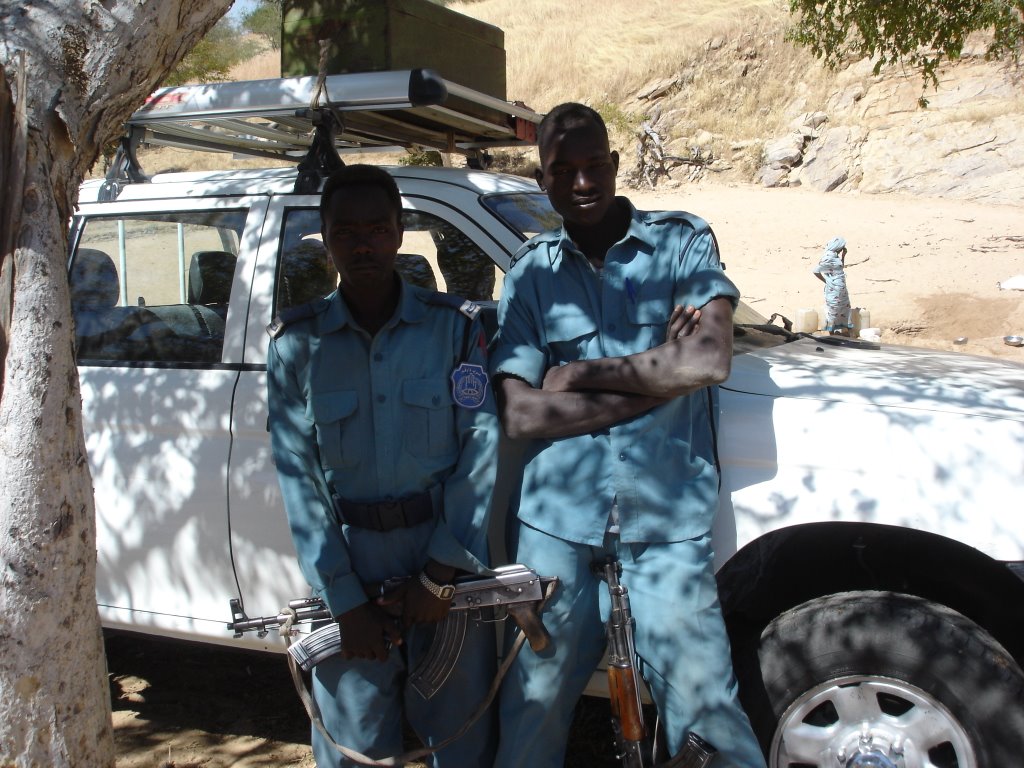
Careful where you point that gun… you may think it makes you look big and tough, but it looks to me like an accident waiting to happen
Who’s calling who a janjaweed?
I had a meeting today with local community leaders, and half the people turned up with whips. This must be one of the few places in the world where turning up to a meeting with a whip gets you fearful respect from your peers – if you have a whip it probably means you have a horse or a camel. And if you have a horse or a camel it means you are powerful enough to hold onto it. Those people who used to have them got them stolen by the ‘nomads’, or rather, by the sub-sector of nomads who are known to many as janjaweed.
The janjaweed identity is quite fluid – you need to ask yourself who’s name-calling and why. Linguistically I am told it simply means ‘men on horseback’. Negative connotations are not new, however, as there have long been groups of such men who roamed around this wild west rustling other people’s cattle. Now, JJ or janjaweed has become a label which is used by the ‘non-Arabs’ (or ‘Africans’) to describe all the Arabs, nomads, and cattle-herders. For example, when my driver points at someone on a horse and says JJ (or “Juliet Juliet Whisky”, as he likes to call them) I have to ask myself which tribe my driver belongs to. I don’t actually know the answer, though I have a few ideas –he must be ‘African’, certainly. To make things more complicated, though most of the ‘Arabs’ are also nomads, moving their herds of cattle from place to place, not all of them are; some of them actually farm the land. And although most of the Africans are farmers, some of them also own cattle, and they move with their cattle while leaving their families at home in the villages. So, the binary Arab/African distinction doesn’t match the nomad/farmer distinction.
I have read that ‘Arab’ was a hazier concept in the early nineties, and that individual tribal identities were given greater importance. Now, every tribe has decided which side of the Arab/African dividing line they stand on. This change was exacerbated by government policies that trained and armed nomads in the late nineties, trying to foster a pro-governmental force in Darfur who could suppress local rebellions and generally carry out dirty work for the government. Nomads were taught about Arab superiority, and that their allegiance lay with the Arabs in Khartoum. Nomads became Arabs. Some of them became full-time janjaweed. Prior to 1989 the nomads of Darfur apparently felt very little affinity with central Khartoum government. (For a good concise account of these fluctuating identities see the Minority Rights Group Report, Lessons from Darfur, at www.minorityrights.org)
NGOs generally talk about nomads and farmers; it sounds less political and is more precise than saying Arab or African. It seems the only time we can comfortably say Arab is when we’re talking about Arab Militias. Arab as a label seems like an insult here. Maybe it’s just because we spend so much time working with and talking to the mainly African IDPs.
So how do the nomads and farmers, who live side by side, interact in daily Darfur life? Here’s a painful example. At this time of year, the farmers are busy harvesting their crops. Many of those who have moved into the IDP camps go back to their fields in the daytime, on donkeys (they only have donkeys and goats now as their horses and camels have been rustled by janjaweed). At night they return to the safety of the camps. Last week I was out in the villages trying to organise training sessions with the few people who have stayed in the villages, but most people were too busy and worried about bringing in the harvest quickly before the cattle came to eat the crops. I saw fields being eaten up by herds of cows, the remaining wheat stalks still standing taller than the cattle as they munched their way through. Later I saw a group of men in dark green uniforms, (hell, let’s be rash and just call them janjaweed), relaxing in the long grass with their guns propped up next to them, as their camels had a good square meal in somebody else’s field.
Darfur is going through a particularly dry period, and the fight for natural resources has become more critical than ever. The scarcity of fertile land means that nomads with hungry cattle naturally find the grass is always greener when it’s been planted and nurtured by farmers. Ultimately everyone is just fighting to get enough to eat. However, sending animals into a wheat field which has been carefully fenced off with thorny bushes is undoubtedly stealing someone else’s hard-earned dinner.
But when my driver points at a straggly-haired child with a big smile, standing next to her cattle at the side of the road in brightly coloured clothes and waving for all she’s worth, and he says jokingly ‘Little Juliet Juliet Whisky’ I know for certain that we can’t just call all nomads janjaweed. Yet I also know what a powerful force that word has for at least half the population of Darfur, and just how difficult it will be to dismantle these increasingly established identities, and stop calling people names.
The janjaweed identity is quite fluid – you need to ask yourself who’s name-calling and why. Linguistically I am told it simply means ‘men on horseback’. Negative connotations are not new, however, as there have long been groups of such men who roamed around this wild west rustling other people’s cattle. Now, JJ or janjaweed has become a label which is used by the ‘non-Arabs’ (or ‘Africans’) to describe all the Arabs, nomads, and cattle-herders. For example, when my driver points at someone on a horse and says JJ (or “Juliet Juliet Whisky”, as he likes to call them) I have to ask myself which tribe my driver belongs to. I don’t actually know the answer, though I have a few ideas –he must be ‘African’, certainly. To make things more complicated, though most of the ‘Arabs’ are also nomads, moving their herds of cattle from place to place, not all of them are; some of them actually farm the land. And although most of the Africans are farmers, some of them also own cattle, and they move with their cattle while leaving their families at home in the villages. So, the binary Arab/African distinction doesn’t match the nomad/farmer distinction.
I have read that ‘Arab’ was a hazier concept in the early nineties, and that individual tribal identities were given greater importance. Now, every tribe has decided which side of the Arab/African dividing line they stand on. This change was exacerbated by government policies that trained and armed nomads in the late nineties, trying to foster a pro-governmental force in Darfur who could suppress local rebellions and generally carry out dirty work for the government. Nomads were taught about Arab superiority, and that their allegiance lay with the Arabs in Khartoum. Nomads became Arabs. Some of them became full-time janjaweed. Prior to 1989 the nomads of Darfur apparently felt very little affinity with central Khartoum government. (For a good concise account of these fluctuating identities see the Minority Rights Group Report, Lessons from Darfur, at www.minorityrights.org)
NGOs generally talk about nomads and farmers; it sounds less political and is more precise than saying Arab or African. It seems the only time we can comfortably say Arab is when we’re talking about Arab Militias. Arab as a label seems like an insult here. Maybe it’s just because we spend so much time working with and talking to the mainly African IDPs.
So how do the nomads and farmers, who live side by side, interact in daily Darfur life? Here’s a painful example. At this time of year, the farmers are busy harvesting their crops. Many of those who have moved into the IDP camps go back to their fields in the daytime, on donkeys (they only have donkeys and goats now as their horses and camels have been rustled by janjaweed). At night they return to the safety of the camps. Last week I was out in the villages trying to organise training sessions with the few people who have stayed in the villages, but most people were too busy and worried about bringing in the harvest quickly before the cattle came to eat the crops. I saw fields being eaten up by herds of cows, the remaining wheat stalks still standing taller than the cattle as they munched their way through. Later I saw a group of men in dark green uniforms, (hell, let’s be rash and just call them janjaweed), relaxing in the long grass with their guns propped up next to them, as their camels had a good square meal in somebody else’s field.
Darfur is going through a particularly dry period, and the fight for natural resources has become more critical than ever. The scarcity of fertile land means that nomads with hungry cattle naturally find the grass is always greener when it’s been planted and nurtured by farmers. Ultimately everyone is just fighting to get enough to eat. However, sending animals into a wheat field which has been carefully fenced off with thorny bushes is undoubtedly stealing someone else’s hard-earned dinner.
But when my driver points at a straggly-haired child with a big smile, standing next to her cattle at the side of the road in brightly coloured clothes and waving for all she’s worth, and he says jokingly ‘Little Juliet Juliet Whisky’ I know for certain that we can’t just call all nomads janjaweed. Yet I also know what a powerful force that word has for at least half the population of Darfur, and just how difficult it will be to dismantle these increasingly established identities, and stop calling people names.
Monday, November 27, 2006
Thursday, November 16, 2006
It's all strangely normal
My daily life is plodding along in a strangely normal sort of way here in Darfur, though of course I know there have been a number of attacks on IDPs recently, not so far from here. The coordination meetings have focused on what we can do, and how we can access those areas which are often out of bounds security-wise for all the NGOs. So there’s a lot of work. Life is busy. The weeks fly by and already it’s Thursday afternoon again – the weekend.
But it’s hard to know what to write as my environment doesn’t quite evoke the same feelings in me as it did at the beginning. I drive around town, rush from one thing to the next, and everything I see is starting to look pretty familiar. As we drive past various armed vehicles, I practice identifying them, and say to the driver ‘Chadians?’, or ‘JJs?’, or ‘Government?’ or ‘Police?’. Or even, the lesser known, ‘JJ police?’ I’m starting to get the hang of it. There are still mysteries of course, like why do soldiers wear those red berets? And often you see groups of armed men walking along the street together, all with Kalashnikovs slung over their backs, all wearing different uniforms, or just normal clothes.
The mornings are chilly and the cold shower is an ordeal that now has to be planned into my day, rather than appreciated, as it was before. The best time is just after work when the water is still warm-ish from the day’s heat. I am discovering small luxuries, like a local chocolate biscuit called Kiko, which I am currently devouring between every meal. I am also trying to create a little garden in the courtyard next to my room – I have been digging away in the sandy soil, trying to sift out the biggest stones. I’ve planted watermelon seeds and sunflower seeds (just what was available here). Now I am watering hopefully and frequently, but so far nothing has appeared.
I’m still learning odd bits of Arabic and chatting away in simple disjointed phrases. After lunch I make coffee and practice writing in charcoal on the concrete next to the kitchen, and the cooks laugh and correct me.
The Sufis have been noisy recently, I hear them singing and chanting at night. They sound like the wander round the streets, but I don’t know exactly where they congregate, and from the safety of my compound, after curfew time, I can’t go out to find them and see what’s happening. They start chanting repetitively at about 10pm, and go on till late. One night they were singing non-stop until 7am, which initially was interesting and atmospheric, but soon became a bit tedious really. I’m going to ask around, and see if I can visit them.
The mornings are chilly and the cold shower is an ordeal that now has to be planned into my day, rather than appreciated, as it was before. The best time is just after work when the water is still warm-ish from the day’s heat. I am discovering small luxuries, like a local chocolate biscuit called Kiko, which I am currently devouring between every meal. I am also trying to create a little garden in the courtyard next to my room – I have been digging away in the sandy soil, trying to sift out the biggest stones. I’ve planted watermelon seeds and sunflower seeds (just what was available here). Now I am watering hopefully and frequently, but so far nothing has appeared.
I’m still learning odd bits of Arabic and chatting away in simple disjointed phrases. After lunch I make coffee and practice writing in charcoal on the concrete next to the kitchen, and the cooks laugh and correct me.
The Sufis have been noisy recently, I hear them singing and chanting at night. They sound like the wander round the streets, but I don’t know exactly where they congregate, and from the safety of my compound, after curfew time, I can’t go out to find them and see what’s happening. They start chanting repetitively at about 10pm, and go on till late. One night they were singing non-stop until 7am, which initially was interesting and atmospheric, but soon became a bit tedious really. I’m going to ask around, and see if I can visit them.
Wednesday, October 25, 2006
Eid Mubarak
Ramadan, helas – Ramadan is finished and now it’s time for Eid, 3 days of feasting, eating biscuits and dates, drinking guava juice and visiting everyone you know. There seemed to be some confusion about when Eid actually started, some people had seen the crescent of the new moon and some people hadn’t yet, so the end of fasting varied slightly, either yesterday or today. In the morning the prayers started as usual at 5.30ish but with a little more fervour than on other days. Then at about 7am (on both days), to celebrate the end of Ramadan, it was all guns blazing, for about an hour. I heard a variety of gun shots, the single sporadic shots from handguns, and then the machinegun rounds chuddering into the air. 7am strikes me as a funny time to want to shoot in the air for joy; you know, you’ve only been up a couple of hours, maybe you’ve been praying, maybe you’re drinking some tea… and suddenly you feel the urge to grab the gun and fire rounds into the air. The kind of release, and violence, I associate with gunfire seems totally inappropriate at 7am. Obviously not. The atmosphere is so festive that gunfire is starting to sound like exploding fireworks. Of course the only really scary thing is that you realise just how many of your neighbours actually have guns.
The bustle in the market just before Eid felt like Christmas Eve in Europe. I went shopping to prepare for everything being shut for a couple of days. By the time I got there, on the morning of Eid-eve, there were no eggs left, for example (bit of a shame seeing as eggs are about all I eat, still, I’m making up for it in biscuits). I feel sorry for the only guard who is working here today, sitting in the courtyard, all on his own. He came into the office this morning with a big smile and a glitzy tray of sugary biscuits and insisted on spraying us all with strong perfume every time we took a biscuit. Things are quiet now, in fact I’m the only one in the office so it might be time to call it a day and try and Eid it with someone else!
The bustle in the market just before Eid felt like Christmas Eve in Europe. I went shopping to prepare for everything being shut for a couple of days. By the time I got there, on the morning of Eid-eve, there were no eggs left, for example (bit of a shame seeing as eggs are about all I eat, still, I’m making up for it in biscuits). I feel sorry for the only guard who is working here today, sitting in the courtyard, all on his own. He came into the office this morning with a big smile and a glitzy tray of sugary biscuits and insisted on spraying us all with strong perfume every time we took a biscuit. Things are quiet now, in fact I’m the only one in the office so it might be time to call it a day and try and Eid it with someone else!
Thursday, October 12, 2006
Camping it
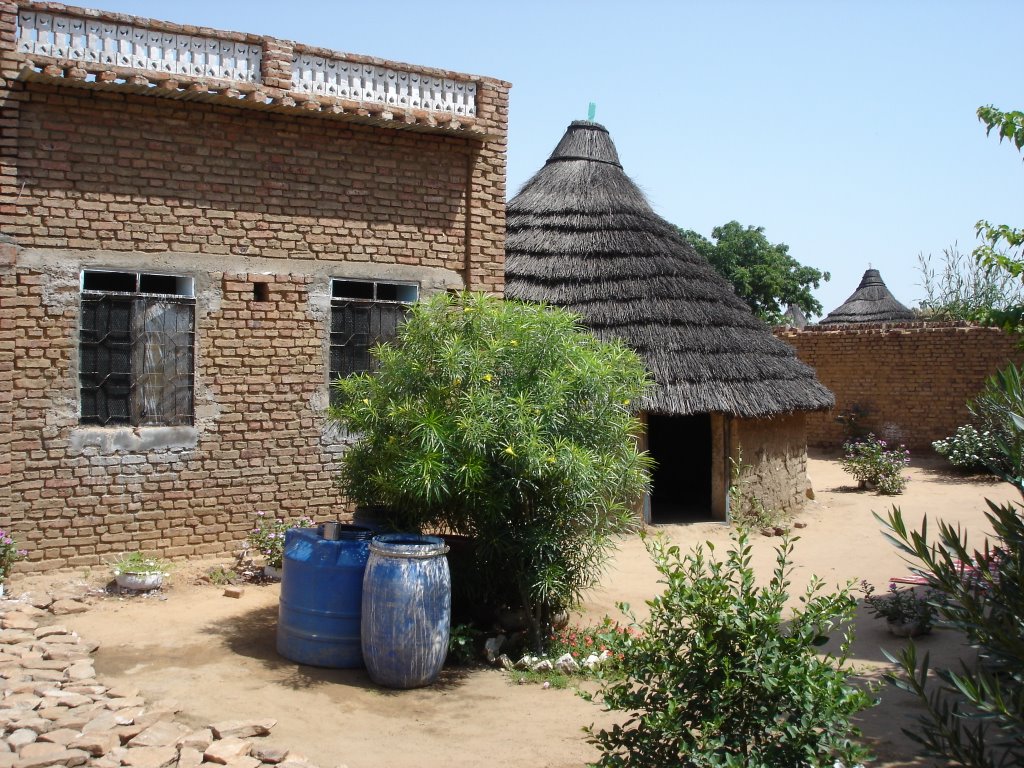
Staying in one of the largest camps in Darfur. There is no running water, it is brought by donkeys, and put in these big blue barrels in the middle of the courtyard, to wash and cook with. No electricity either, (except with the generator) and no phone network. I loved being here. At night it's hot and people sleep on mats outside.
Holy Ramadan
I am now half-way into my first experience of the holy month of Ramadan. Though I am not actually fasting myself, when I work in the field I am obliged to be very discrete about eating or drinking. Usually I don’t eat at all, and in order to drink I have to find a corner to hide in (the car) and secretly slurp water. Not eating is not too difficult in this heat, but not drinking makes you feel thoroughly terrible. My staff told me that for the first few days they have bad headaches, but then their bodies adapt. I haven’t yet done a full Ramadan-day-fast. I guess I should try it. It may help me understand what everyone is going through.
I find myself really attracted to the rhythm of praying. It is not particularly the relationship with God that attracts me; it is more the discipline of the daily rituals that I find appealing. Everything stops for prayer time – we have to organise workshops so that they finish in time for 3 o’clock prayer, and during Ramadan that means the working day is pretty much over. The rest of the day is devoted to praying, resting, and then feasting.
The day begins at about 5, in order to eat before the sun comes up. I became aware of this routine early on in Ramadan, when I awoke at 5ish to the sound of a mob of children on the street, banging pots and pans and shouting loudly. I had no idea what was going on. I listened, in the darkness, and I started to panic. There were lots of very over-excited children just outside my window, with threatening sounding kitchen utensils, and from what I could make out they were shouting “Huwaji, go home, huwaji, go home”. (huwaji meaning foreigner). Oh my god, I thought, this is going to be the most embarrassing security incident yet - I’m going to be attacked by twenty hyper eight year olds. I leapt out of bed, quickly put my shoes on (I had been advised to always sleep with something decent on, just in case) and ran outside into the courtyard to ask the guard what was going on. The children were just on the other side of the wall. The guard laughed and told me that all was ‘tamam’, that all was OK. He reassured me. Soon the children moved on, to go and scare another sleeping foreigner no doubt, and I eventually went back to bed.
The incident played on my mind a bit, and I didn’t understand what had happened until two days later when the guard came into the office and asked for someone to translate for him. Through the translator he explained that the children had been chanting “huwaji gaum” meaning, “foreigner wake up”, which is by all accounts a very friendly thing to do, during Ramadan. The children go through the streets to wake everyone up, so that people get a chance to eat before fasting begins. I suppose they think I’m fasting too, and they just wanted to help. They haven’t been back since then, but there’s generally so much movement on the street, and blaring of mosques at that hour, that I wake up anyway.
I find myself really attracted to the rhythm of praying. It is not particularly the relationship with God that attracts me; it is more the discipline of the daily rituals that I find appealing. Everything stops for prayer time – we have to organise workshops so that they finish in time for 3 o’clock prayer, and during Ramadan that means the working day is pretty much over. The rest of the day is devoted to praying, resting, and then feasting.
The day begins at about 5, in order to eat before the sun comes up. I became aware of this routine early on in Ramadan, when I awoke at 5ish to the sound of a mob of children on the street, banging pots and pans and shouting loudly. I had no idea what was going on. I listened, in the darkness, and I started to panic. There were lots of very over-excited children just outside my window, with threatening sounding kitchen utensils, and from what I could make out they were shouting “Huwaji, go home, huwaji, go home”. (huwaji meaning foreigner). Oh my god, I thought, this is going to be the most embarrassing security incident yet - I’m going to be attacked by twenty hyper eight year olds. I leapt out of bed, quickly put my shoes on (I had been advised to always sleep with something decent on, just in case) and ran outside into the courtyard to ask the guard what was going on. The children were just on the other side of the wall. The guard laughed and told me that all was ‘tamam’, that all was OK. He reassured me. Soon the children moved on, to go and scare another sleeping foreigner no doubt, and I eventually went back to bed.
The incident played on my mind a bit, and I didn’t understand what had happened until two days later when the guard came into the office and asked for someone to translate for him. Through the translator he explained that the children had been chanting “huwaji gaum” meaning, “foreigner wake up”, which is by all accounts a very friendly thing to do, during Ramadan. The children go through the streets to wake everyone up, so that people get a chance to eat before fasting begins. I suppose they think I’m fasting too, and they just wanted to help. They haven’t been back since then, but there’s generally so much movement on the street, and blaring of mosques at that hour, that I wake up anyway.
Wednesday, September 27, 2006
I read you loud and clear
There is now a new addition to my bag – not only do I have to carry my mobile phone (though the network is often off for days at a time), my satellite phone, and thick wodges of grubby cash, but there is also the cumbersome chattering radio.
The radio is like a high-tec walkie talkie. Only one person talks at a time, you have to use code language and say vaguely comical things like ‘that is a good copy’, ‘affirmative’ or (my favourite) ‘Roger Roger’. And of course everyone can hear what everyone else is saying, 24 hours a day. You overhear confused conversations as people try to avoid mentioning specific names or places.
‘November Juliet Kilo One, this is Yankee Foxtrot Three Two, how do you read me?’
‘Five by five, I am now at the location, over’
‘Is that the first location? Over’
‘Negative, it is the other location, ready to be picked up, over’
‘Did you remember to bring the thing I asked you to bring? Over’
‘Was that the thing you asked me for yesterday or the other thing you wanted me to bring for the meeting tomorrow? Over’
‘It was the thing that Two Two wanted you to bring to the next location’ etc etc.
And if you slip up and mention a name the faceless Big Brother who is always listening may well interrupt with a ‘PLEASE BE MORE SERIOUS, PLEASE BE MORE SERIOUS’ and you are swiftly and publicly humiliated.
Every evening there is the radio check, and Big Brother goes through the list of NGO workers to check everyone is alive and well. You have to listen for your call sign, and then respond with a ‘loud and clear, goodnight’. At Thursday night parties there is a momentary interruption at 19.30 as people fumble for their radios and dutifully respond to BB as best they can, trying to avoid too much background noise. Though the party has usually only just begun, the radio check means it is nearly over... Soon after it’s curfew, and you find yourself driving back home again, bumping along the quiet dark streets, ready for another early night.
Over and out.
The radio is like a high-tec walkie talkie. Only one person talks at a time, you have to use code language and say vaguely comical things like ‘that is a good copy’, ‘affirmative’ or (my favourite) ‘Roger Roger’. And of course everyone can hear what everyone else is saying, 24 hours a day. You overhear confused conversations as people try to avoid mentioning specific names or places.
‘November Juliet Kilo One, this is Yankee Foxtrot Three Two, how do you read me?’
‘Five by five, I am now at the location, over’
‘Is that the first location? Over’
‘Negative, it is the other location, ready to be picked up, over’
‘Did you remember to bring the thing I asked you to bring? Over’
‘Was that the thing you asked me for yesterday or the other thing you wanted me to bring for the meeting tomorrow? Over’
‘It was the thing that Two Two wanted you to bring to the next location’ etc etc.
And if you slip up and mention a name the faceless Big Brother who is always listening may well interrupt with a ‘PLEASE BE MORE SERIOUS, PLEASE BE MORE SERIOUS’ and you are swiftly and publicly humiliated.
Every evening there is the radio check, and Big Brother goes through the list of NGO workers to check everyone is alive and well. You have to listen for your call sign, and then respond with a ‘loud and clear, goodnight’. At Thursday night parties there is a momentary interruption at 19.30 as people fumble for their radios and dutifully respond to BB as best they can, trying to avoid too much background noise. Though the party has usually only just begun, the radio check means it is nearly over... Soon after it’s curfew, and you find yourself driving back home again, bumping along the quiet dark streets, ready for another early night.
Over and out.
Saturday, September 23, 2006
Vengeance through Yoga
There is a lot of work to do here, and a strong protestant-work-ethic culture. If you’re not working, then what the hell are you doing here? Go back home and spend all week making money if you want to justify putting your feet up and taking time off. So, six days a week it is, 8.30 till at least 7 everyday. Fortunately, I’ve been really enjoying my work so far. I’ve spent my first full week training the local staff on hygiene promotion. Basically, it’s been a week talking about poo, varieties in latrine design, and the importance of washing your hands.
However, you do need some entertainment other than work. Current activities include going running in the mornings with a group of big strong fast guys, who seem to be able to sprint across the sand even in heavy leather walking boots. Needless to say I bring up the rear and am pretty sweaty and red by the end of our wake-up jog. Afterwards, back at the guesthouse we do sit-ups and press-ups, and the guys ‘push weights’. We’ll see how long I last, but at the moment I’m determined to get a bit fit.
However, feeling slightly fed up of being the sweatiest and slowest member of the jogging team I decided to seek vengeance through yoga. Yesterday evening as the sun was setting (and the mosquitoes feeding) I led a yoga class in the courtyard, and reduced the big strong guys to shaky downward dogs and wobbly warriors… Not as easy as it looks, eh?! But I hope they come back again next week.
However, you do need some entertainment other than work. Current activities include going running in the mornings with a group of big strong fast guys, who seem to be able to sprint across the sand even in heavy leather walking boots. Needless to say I bring up the rear and am pretty sweaty and red by the end of our wake-up jog. Afterwards, back at the guesthouse we do sit-ups and press-ups, and the guys ‘push weights’. We’ll see how long I last, but at the moment I’m determined to get a bit fit.
However, feeling slightly fed up of being the sweatiest and slowest member of the jogging team I decided to seek vengeance through yoga. Yesterday evening as the sun was setting (and the mosquitoes feeding) I led a yoga class in the courtyard, and reduced the big strong guys to shaky downward dogs and wobbly warriors… Not as easy as it looks, eh?! But I hope they come back again next week.
Saturday, September 16, 2006
In the Kitchen
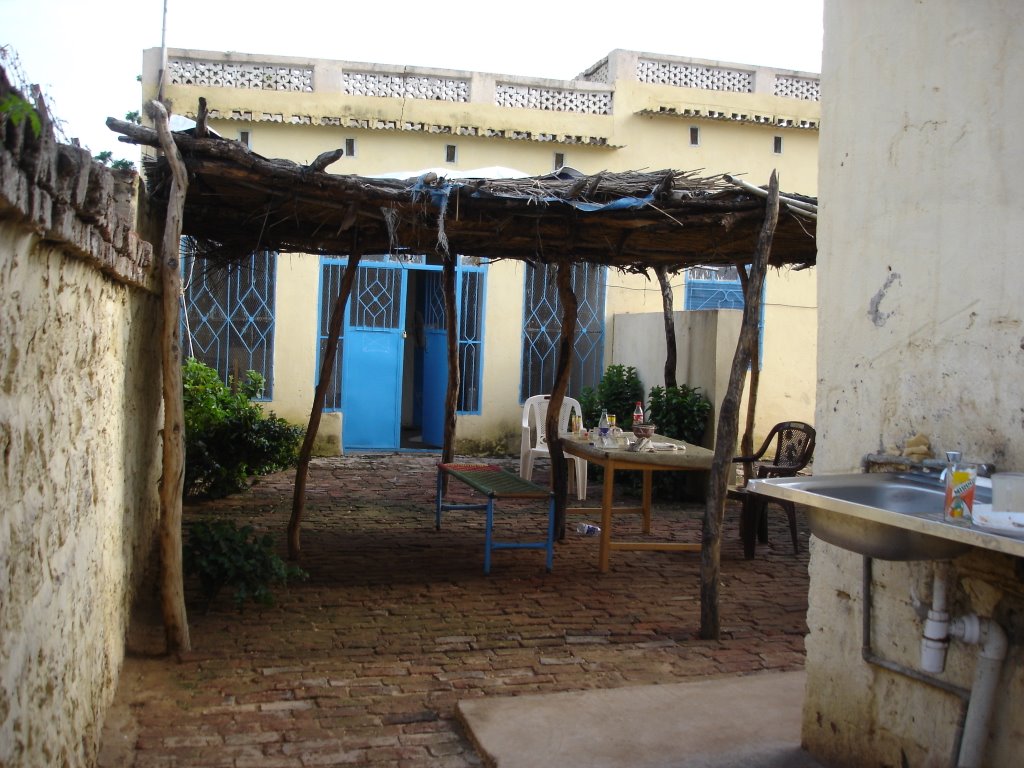 I’m sitting at this table outside where we eat all our meals. For breakfast today I had real cornflakes (a luxury procured from the African Union troops, I think) with powdered milk, and tea. Failing cornflakes we usually have a flat, round salt-less bread and tea. Lunch and supper are pretty good, the cook has come up with some vegetarian things to eat with the obligatory rice; aubergine ratatouille type mixture, cooked chard/spinach, and lentil dhal (but the lentils are also a procured luxury, and the supply is limited). My favourite so far has been yummy fresh eggs and greasy chips. The only problem, as we were discussing over dinner the other night, is that everything seems to have a certain amount of grit in it. The spinach especially has a sandy crunchy texture which is most unpleasant, and means the best thing to do is simply avoid chewing and swallow quickly. So, there is stuff to eat, and at this rate I’m not going to lose 5-15 kilos, as lots of other international staff seem to have done.
Sitting here earlier today, the cook was helping me with my Arabic, and I was helping her clean up and teaching her bits of English in exchange. She makes me laugh so much. It’s been a very happy weekend.
Jusqu’ici, tout va bien
I’ve only been here in Darfur a few days, but my first impressions of the town are very positive. It is quiet, rural and spacious, with mud huts next to traditional square brick houses painted yellow and turquoise. There are lots of noisy donkeys, goats, a few camels, and too many rats and beetly things for my liking. Big crickets hop everywhere, and even come into my room at night to chirrup loudly from the safety of my shoes. I’m quickly getting used to having a multitude of insects landing on me, trying to attack me in the shower, or simply attempting to walk over me if I happen to be in their way. But, I have to say the surprise animal resident here has to be the common hedgehog! God knows how they got to Darfur.
Although I know that just 20 or 30 kilometres from here things are very different, inside the town life is deceptively peaceful. Like a green oasis of calm. And being the rainy season, it really is green. The ‘wadis’ (rivers that only fill up when the rains come) are full, and the vegetation is thick and plentiful. When you see the grass waist high, the huge cool mango trees, it is hard to believe that there is not enough food for people to eat here. It makes you realise to what extent hunger can be a political problem; people are displaced and so can no longer cultivate their land.
I can’t yet recognise who belongs to which ethnic group or faction – I can’t distinguish a Janjaweed from a Fur, Masaalit, Zaghawa or Chadian. The only hint I have been given is that the Janjaweed won’t smile at me in the market. But I haven’t seen anyone like that yet. In fact, I’ve been surprised how generally well-received the international community seems to be; people smile and wave at me, especially the women, and children continuously shout ‘hawajia’, meaning foreigner.
Although I know that just 20 or 30 kilometres from here things are very different, inside the town life is deceptively peaceful. Like a green oasis of calm. And being the rainy season, it really is green. The ‘wadis’ (rivers that only fill up when the rains come) are full, and the vegetation is thick and plentiful. When you see the grass waist high, the huge cool mango trees, it is hard to believe that there is not enough food for people to eat here. It makes you realise to what extent hunger can be a political problem; people are displaced and so can no longer cultivate their land.
I can’t yet recognise who belongs to which ethnic group or faction – I can’t distinguish a Janjaweed from a Fur, Masaalit, Zaghawa or Chadian. The only hint I have been given is that the Janjaweed won’t smile at me in the market. But I haven’t seen anyone like that yet. In fact, I’ve been surprised how generally well-received the international community seems to be; people smile and wave at me, especially the women, and children continuously shout ‘hawajia’, meaning foreigner.
Subscribe to:
Posts (Atom)